Grand Mountain Adventure 2
- 4.4
- Rating
- 1.00M
- Installs
- Free
- Price
 Analysis by App-foxy
I spent time with Grand Mountain Adventure 2 as a mobile sports game, and my first impression was that it wants to make skiing and snowboarding feel like a place you can wander through rather than a series of isolated races. That difference matters. If you enjoy relaxed exploration, short challenges, and the feeling of gradually learning a mountain, this is much more appealing than a standard downhill game built around repeating one track.
It is free to download, aimed at Everyone, and developed by Toppluva AB. The game has reached over a million installs and holds a 4.6 average from around 5,400 ratings, which fits my experience: there is a polished, inviting surface here, but the best way to enjoy it is to understand what kind of game it is before expecting a full simulation or an instant arcade rush.
Getting started without turning the first session into a chore
The initial setup is straightforward on a compatible device, but I found that the first few minutes are important because the game asks you to adjust to movement, slopes, obstacles, and the rhythm of exploration. Skiing games often look simple in screenshots, yet touch controls can feel slippery until your hands learn how much input is needed. My advice is not to rush toward the hardest-looking activity. Use the opening area to test gentle turns, braking, and the way the character responds when the terrain changes.
You May Also Like

 Google Keep - Notes and lists
Google Keep’s Quiet Growth Shows the Appeal of Simpler Notes
As mobile work gets busier, Google Keep keeps winning a simple contest: capture a thought quickly, find it later, and get on with the day.

 Blood Strike: 2.5 Anniversary
Blood Strike’s Loadouts Turn Every Drop Into a Tactical Gamble
A close look at Blood Strike’s custom loadouts: how fast access to signature weapons reshapes its battle royale rhythm, rewards preparation, and narrows the gap between fights.

 Pandora - Music & Podcasts
Pandora’s Music Is Easy to Start, but Harder to Recover
Pandora’s strength is its low-effort path from a seed to a station. Its weak spot is how much confidence it asks you to place in connection, setup, and quiet recovery.

 8 Ball Pool
 Is Built on Rivalries, Rematches, and Routine
A close look at the rivalries, rematches, shared routines, and unanswered safety questions that turn a quick pool match into a persistent mobile community.

 Samsung Music
’s Quiet Strength Is Playing What You Already Own
Its reach comes less from spectacle than from dependable access to a personal library. That simplicity is both the app’s strongest retention engine and its ceiling.

 AccuWeather: Weather Radar
AccuWeather Review: A Quick, Clear Forecast for Everyday Decisions
For everyday plans, the best forecast is the one you can understand quickly. AccuWeather makes rain timing, radar, and local conditions easy to act on, with a few trade-offs.
More From Our News Desk



Grand Mountain Adventure 2 runs on Android devices using Android 11 or later. That requirement is worth checking before downloading, especially if you are installing it on an older phone or a tablet that is no longer updated. A device that technically meets the operating-system requirement may still offer a less comfortable experience if it has limited free storage, aggressive background-app management, or a screen that makes precise steering awkward.
One practical setup check is to close demanding apps before playing, particularly if you normally keep several games, video apps, or browser tabs open. I also recommend starting with a stable connection when launching the game for the first time, even though the important point is simply to avoid diagnosing a temporary setup problem as a gameplay fault. If the first launch pauses, reloads, or behaves oddly, restarting the game and checking the device connection is a more sensible first step than repeatedly tapping the screen.
The current version is 1.07001, so keeping the installation current is sensible when you are troubleshooting. Updates can change how a game behaves on particular devices, and an outdated build can create confusion when you are comparing your experience with newer instructions or player discussions. I would also leave some free space on the device rather than installing it on a phone that is already struggling to manage storage.
What the controls feel like in ordinary play
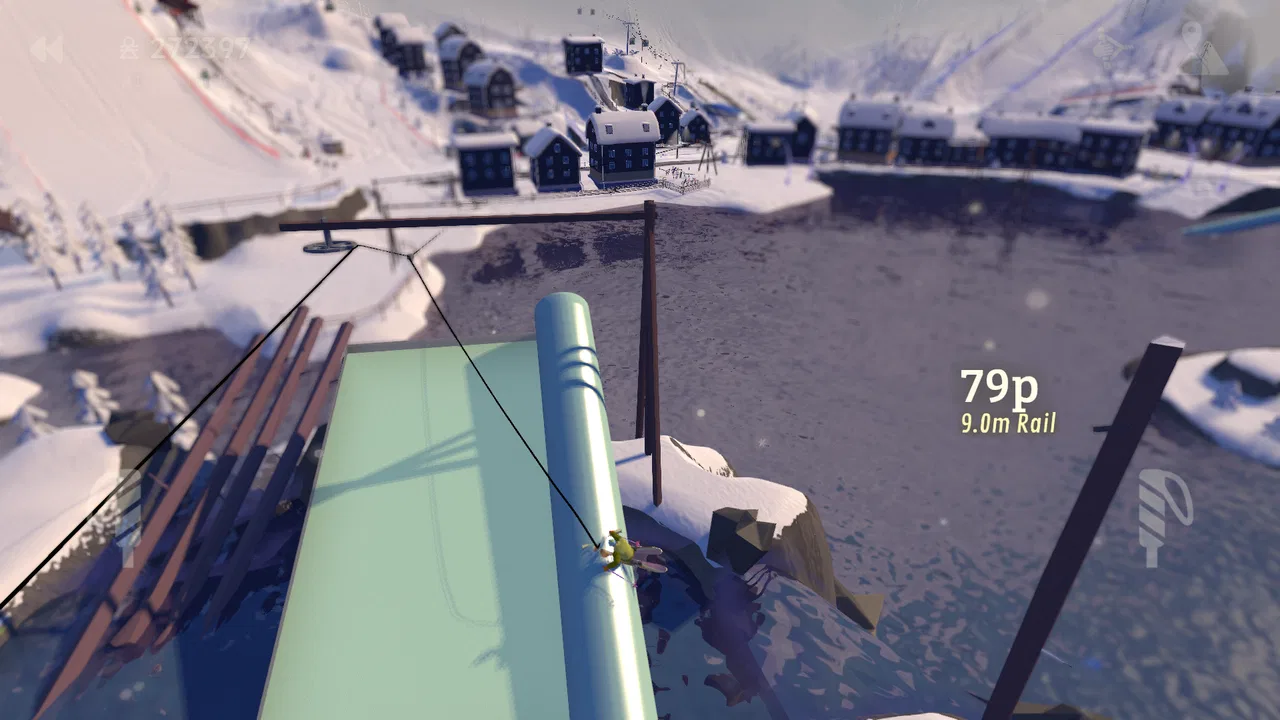
Once I stopped trying to make every turn perfect, the controls became much more enjoyable. The game works best when I treated the mountain as a route to read instead of a track to attack. A wide slope gives me room to build confidence, while a narrow section rewards planning before the turn rather than frantic correction halfway through it.
That is one of the less obvious strengths of the game: exploration gives you a reason to remember the landscape. I began recognizing useful lines, awkward approaches, and places where a small mistake could send the run away from the direction I wanted. This makes short sessions feel meaningful. Even when I did not complete a challenge, I often learned a better route for the next attempt.
The trade-off is that players looking for immediate, perfectly predictable arcade handling may need patience. Touch input is not the same as a physical controller, and a beautiful downhill view can make it tempting to steer too aggressively. I found that small, early corrections were more reliable than large movements made after losing control. That is a simple habit, but it makes the difference between feeling that the game is unfair and realizing that the mountain is asking for better timing.
For a realistic everyday use case, imagine having ten minutes before leaving home or during a break. I would open the game, spend a few minutes exploring or repeating a familiar section, and stop without needing to commit to a long campaign session. That flexibility suits mobile play. It is also a good reason to avoid beginning with the expectation that every session must end in a major achievement.
Where players are most likely to get stuck
The first common stumbling block is confusing open exploration with a conventional level list. In a typical sports game, the next activity is obvious: select a course, race, and return to a menu. Here, the environment itself is part of the interface. If you keep searching for a single linear path, you can miss the point of moving through the mountain and discovering what is available around you.
A second source of frustration is repeating a difficult section without changing the approach. When a run goes wrong, I get more value from slowing down, looking at the slope, and choosing a different line than from immediately trying the same movement again. The game rewards observation more than button speed in those moments. That is particularly useful advice for snowboarding, where a small change in direction can have a larger effect than expected.
Another issue is assuming that a missed objective means the whole session was wasted. I found the game more satisfying when I separated practice from completion. A first attempt can be used to learn the route, while a later attempt focuses on cleaner movement. This mindset reduces the pressure to perform perfectly and makes the open-world structure feel purposeful rather than distracting.
There is also a comfort issue. Long downhill sessions can become tiring if you hold the phone in one position and make constant small corrections. I prefer shorter bursts, with a quick pause between attempts. That is not a technical feature, but it is a practical way to keep the controls precise and avoid blaming the game when fatigue is affecting my hands.
Recovering from a bad run and separating game problems from device problems
When a run turns messy, I first separate a bad line or mistimed correction from an actual interruption: if the character still responds, I treat it as a play problem and adjust my route rather than restarting in frustration. If the game itself stalls, I make one change at a time—reopen it, then check the phone’s workload or connection—so I can tell whether the cause is the app or the device.
A simple recovery workflow
When something goes wrong, I use a short recovery routine. First, I check whether the character is still responding to input. If the game is active but the run is poor, I restart the attempt mentally rather than treating the mistake as a technical failure. I slow down on the next pass, use a wider line, and avoid making several corrections at once.
If the screen stops responding, the sound behaves strangely, or the game appears frozen, I leave the app and open it again. Before doing anything more drastic, I check whether another app is consuming the device’s attention and whether the phone has enough free storage. I would not clear saved information or reinstall immediately, because those steps can create a new problem if progress or local settings are involved.
For a connection-related hiccup, I would move from an unstable network to a more reliable one, then retry the launch. If the problem happens only once, it may be a temporary interruption rather than a fault with the game itself. If it returns consistently, noting exactly when it occurs is useful: during startup, while moving between areas, or after the device has been idle. That detail is far more helpful than simply saying that the game “does not work.”
Another useful habit is to change one thing at a time. Restart the game, test it, and only then consider restarting the phone. If you change the network, reinstall the app, alter battery settings, and close every background process at once, you will not know which action helped. A calm sequence makes troubleshooting faster and avoids unnecessary disruption.
When the phone, network, or expectations are the real cause
Not every rough experience points to a defect in Grand Mountain Adventure 2. A phone that is hot, nearly full, or busy with other processes can make any visually rich game feel less responsive. If the game improves after closing background apps or letting the device cool, the hardware conditions were probably contributing to the problem.
Input can also feel inconsistent when fingers are damp, the screen protector is thick, or the phone is being held at an awkward angle. Because the game depends on controlled movement, those small physical factors matter more than they would in a turn-based title. I get better results with a clean screen, a stable grip, and enough space to make deliberate gestures without covering the view.
Battery-saving modes deserve attention as well. They can limit background activity or reduce performance, and the result may look like a game issue. I do not recommend changing system settings blindly, but checking whether a restrictive power mode is active is a reasonable step when the game suddenly feels different from an earlier session.
Expectations are another hidden cause of disappointment. This is a sports game with an open-world skiing and snowboarding focus, not a replacement for a console simulation with extensive physical controls. If you want realistic equipment tuning, competitive online structure, or the precision of a dedicated controller, this may not satisfy you. If you want a mountain to explore at your own pace, with challenges that fit into mobile sessions, its design makes much more sense.
How it compares with familiar alternatives
Compared with a standard downhill racer, this game gives exploration more importance. A conventional racer is usually better when I want an immediate start, a clear finish line, and a quick comparison of performance. Grand Mountain Adventure 2 is better when I want to choose my own direction, practice a section, and enjoy the setting between objectives.
Compared with a realistic skiing simulator, it is easier to approach but less suited to players who want every movement to model real equipment and snow. The simplified mobile-friendly design helps me play with one hand or in short sessions, yet it also means that serious simulation fans may find the experience too relaxed.
Compared with endless-runner sports games, it offers a stronger sense of place. The downside is that the freedom can make progress feel less obvious until I learn how to read the environment. In other words, the game trades immediate clarity for discovery. That is a worthwhile exchange for me, but not for someone who wants a tightly directed sequence of levels.
What the free model means in practice
The game is free, with optional in-app purchases ranging from $5.99 to $9.99 per item. I would approach it as a free starting point rather than assuming that every part of the experience is designed around unlimited access from the first minute. The sensible workflow is to play enough to understand the movement and exploration before deciding whether any purchase adds value for your habits.
I also appreciate that the Everyone age rating makes it easy to recommend for general family play, although younger players may still benefit from an adult understanding how optional purchases work on the device. That is ordinary mobile-game housekeeping, but it matters when a game is accessible to a broad audience.
The purchase structure is a reason to be clear about who should skip the game. If you dislike optional spending in free-to-play games on principle, a paid sports title or a console game may be a better fit. If you are comfortable trying a free game first and making your own decision later, the model gives you room to judge the controls and atmosphere before committing money.
Who will enjoy it, and who should choose something else
I would recommend it to players who like scenic exploration, gentle progression, and sports games that do not demand a full uninterrupted evening. It is especially suitable for someone who enjoys learning routes gradually. The mountain becomes more interesting as you stop treating it as decoration and start using its shape to plan movement.
I would be more cautious recommending it to players who need a clear menu-driven structure, dislike repeating attempts, or expect every run to feel fast and competitive. People with older phones should also check the Android requirement and consider the condition of their device before assuming that a poor session reflects the game alone.
My strongest practical tip is to give the game a fair trial in two different moods: once during a short break, and once when you have enough time to explore without rushing. The first test shows whether the controls fit your hands. The second shows whether the open-world design keeps you interested after the novelty of the snow wears off. Those are different questions, and answering both prevents a quick first impression from deciding everything.
After using it this way, I see Toppluva AB’s game as a confident mobile sports experience with a clear personality. It is not trying to be the deepest skiing simulator or the most intense arcade racer. Its appeal comes from combining movement with a place worth learning, while keeping sessions flexible enough for everyday use.
My final view is positive, with a practical qualification: the best experience comes from treating the mountain as something to explore, not merely a track to finish. Check that your device meets the Android 11 requirement, keep the installation current, start with manageable routes, and use simple recovery steps before blaming the app when a session misbehaves. For players who want a free, approachable snow-sports adventure and can accept optional purchases, this is an easy game to try. For strict simulation fans or anyone who wants instant, linear competition, a different sports game will probably be the better choice.
FAQs for Grand Mountain Adventure 2
01What is Grand Mountain Adventure 2 about?
Grand Mountain Adventure 2 is an open-world skiing and snowboarding game that lets players explore beautifully crafted alpine environments. Players can navigate through various challenges, complete tasks, and enjoy the freedom of carving their paths on expansive mountains. It's a sequel that builds on the original with enhanced graphics and more immersive gameplay.
02What are the system requirements for Grand Mountain Adventure 2?
To enjoy Grand Mountain Adventure 2, you'll need an Android device with at least Android 8.0 or an iOS device with iOS 12.0 or later. The game is optimized for both smartphones and tablets, but a device with a larger screen may enhance the gameplay experience due to the detailed graphics and expansive environments.
03Is Grand Mountain Adventure 2 a free-to-play game?
Grand Mountain Adventure 2 offers a free-to-play model with optional in-app purchases. While the initial download provides access to several mountains and features, players can unlock additional content and maps through purchases. This allows users to enjoy the game without spending, but offers more content for those who choose to invest.
04Does Grand Mountain Adventure 2 require an internet connection?
Grand Mountain Adventure 2 can be played offline, making it perfect for gaming on the go without worrying about connectivity. However, some features, such as leaderboards and certain updates, require an internet connection. Playing online can enhance your experience by connecting with other players and accessing the latest content.
05What makes Grand Mountain Adventure 2 different from other skiing games?
Grand Mountain Adventure 2 stands out with its open-world design, allowing players to explore vast alpine environments without restrictions. The game offers realistic physics that enhance the skiing and snowboarding experience, as well as a rich variety of challenges and secrets to discover. Its stunning graphics and immersive soundscapes create a truly captivating experience.
Pros
- Stunning open-world graphics enhance immersion.
- Intuitive controls make gameplay smooth and fun.
- Variety of terrains keeps the experience fresh.
- Multiplayer mode offers engaging social play.
- Frequent updates bring new content regularly.
Cons
- Limited free content; in-app purchases needed.
- Occasional performance lags on older devices.
- Online play requires a stable internet connection.
- Some areas feel repetitive after a while.
- Battery consumption is relatively high.

Grand Mountain Adventure 2
Gallery